

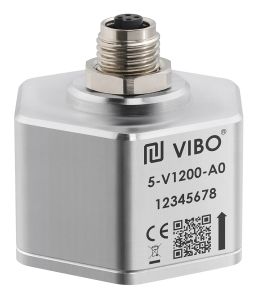
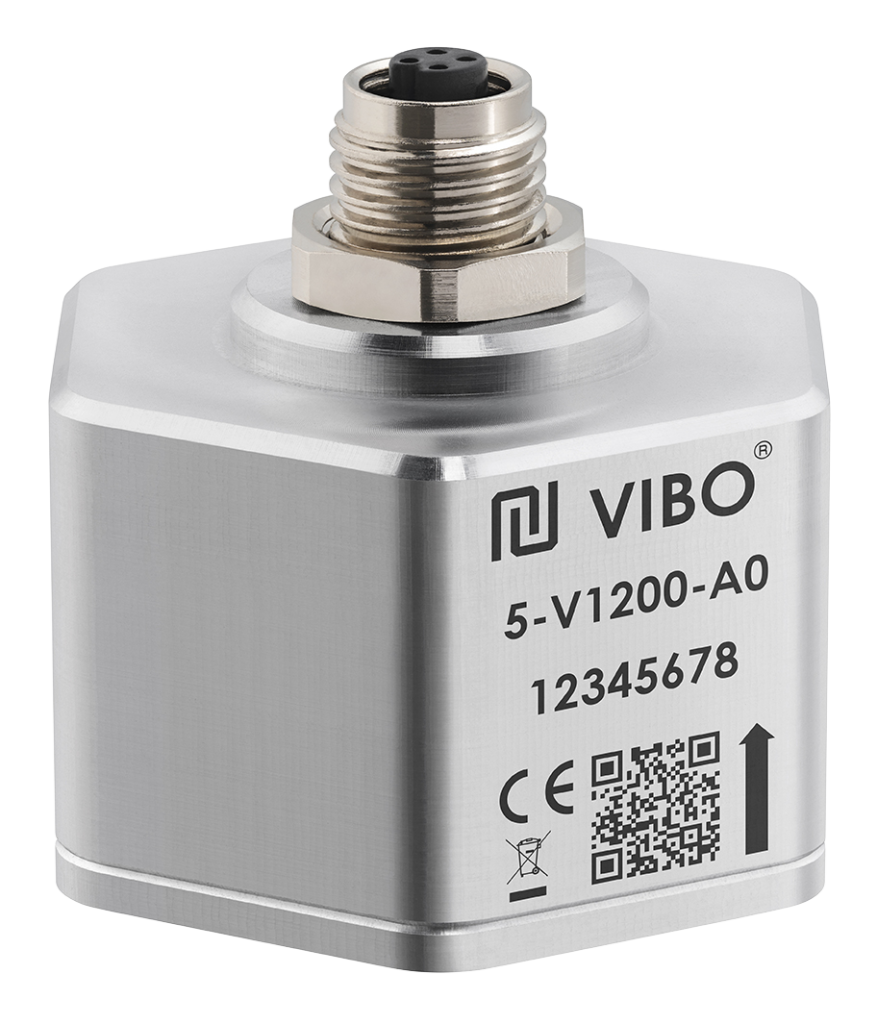
Vibration sensor with edge processing capabilities designed for predictive maintenance and advanced condition-based monitoring
Key Performances
| Input range | ±8 / 16 / 32 / 64 g (user configurable) |
|---|---|
| Sensitivity | 1.4 / 2.8 / 5.6 / 11.2 mg/LSB (Eq. to 100 mV/g @ 8 g, 10 mV/g @ 64 g) |
| Operating temperature | -40 to +125°C |
| Frequency response | 0.5 to 20000 Hz |
| Sensitivity error | ± 10 % (over temperature range) |
| Noise density | 30 µg/√Hz (4 mg rms from 0.5 to 20000 Hz) @ 16g |
| Current consumption | 7.5 mA @ 24 V |
Key Features
- Single-axis vibration sensor
- Acceleration, velocity, and envelope outputs
- RS485/MODBUS RTU interface
- Selectable input range from ±8 to ±64 g
- M5 4-pins connector
- Programmable digital filters
- Configurable indicators: peak, peak-peak, RMS, crest factor
- Compact size, 8 cm3, 20 grams
- M6 mounting interface
Key Applications

Motors
Pumps
Wind turbine
Shaft
Gearing
Bearing
Pushing the limits of frequency domain analysis thanks to MEMS technology
For accurate sensing of acceleration due to any vibration, VIBO is powered by Tronics’ state-of-the-art Micro-Electro-Mechanical Systems (MEMS) technology, which is designed to sustain the most demanding applications for both motion or vibration sensing.
Thanks to its low-noise and excellent sensitivity performance over its high bandwidth, VIBO is designed to substitute legacy vibration sensors used to detect large or tiny mechanical issues from imbalance to bearing faults and gear tooth cracks.
Seamless integration into industrial networks
VIBO features a built-in MODBUS RTU / RS485 interface that allows a direct connection to industrial fieldbuses and streamlines its integration into existing factory infrastructures.
Designed for demanding predictive maintenance and advanced condition-based monitoring of critical industrial assets
VIBO is a high bandwidth MEMS vibration sensor that enables continuous monitoring of machine vibrations. Embedded in spindles, motors, pumps, fans, gearboxes, compressors, or generators, VIBO detects early signs of failure such as imbalance, misalignment, bearing and gearing issue.
Transforming raw acceleration measurement to smart machine health indicators
Besides delivering raw acceleration, velocity and envelope data, its embedded edge processing capabilities enable VIBO to output key machine health indicators such as peak, RMS and crest factor, reducing data transmission speed from 1 Mb/s to few bytes per hour.